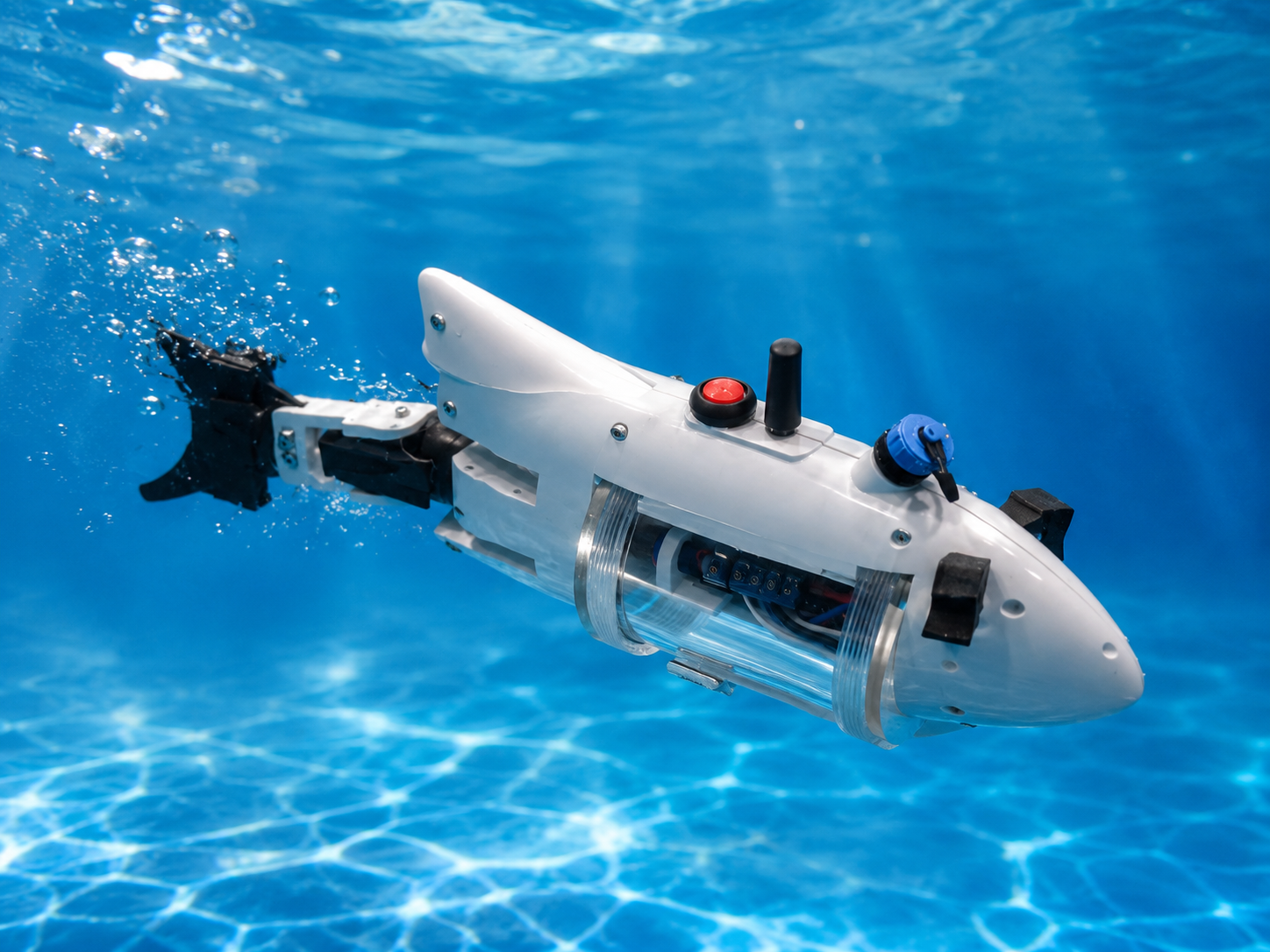
Research-inspired, product-focused.Real motion in water is the common language across the OceanMotion Lab family.
OceanMotion Lab is built around a simple idea: intelligence becomes easier to understand when it can be seen moving through the physical world.
We use fish-inspired bodies, real-water experiments and progressive product design to connect mechanics, sensing, feedback and embodied behavior in one coherent learning pathway.
Rather than treating mechanics, sensing and control as isolated topics, OceanMotion Lab organizes them as a progression. Each product exposes another layer of underwater intelligence while preserving something important: the behavior remains visible, testable and discussable in water.
Product ideas are shaped by questions from biomimetics, hydrodynamics and underwater robotics—translated into forms that are easier to build, observe and communicate.
Users do not only read about propulsion or sensing. They assemble, launch, observe and compare physical systems whose behavior changes in front of them.
Shells, tails, actuation and sensing are treated as meaningful system variables, allowing the product family to grow in capability without losing clarity.
The pathway starts with visible mechanics, then introduces sensing and feedback, then moves toward more capable experimental platforms and future depth-control behavior.
Stored energy, linkage motion, tail oscillation and propulsion—made visible without electronics.
A protected core, speed variation, light sensing and visual feedback introduce responsive behavior.
Richer actuation, payload concepts and real-water demonstrations support higher-level technical discussion.
Active ascent and descent will extend the pathway toward fuller underwater autonomy.
These four ideas provide a common language for explaining the product family—from a simple elastic-powered swimmer to more advanced robotic fish systems.
Geometry, shell morphology and tail form shape how a system interacts with water.
Energy and actuation become oscillation, thrust and observable movement.
Environmental inputs become measurable signals that can influence system response.
Physical design, actuation and sensing come together as embodied interaction with the environment.
For education programs, technical demonstrations, pilot projects and distribution conversations.